To help solve the mysterious puzzle surrounding the origins of the ancient Egyptian people and the ancient biblical Hebrews, we must begin to unscramble the data and clues left to us within the often biased fields of Archaeology, Egyptology, Anthropology, Linguistics, and Genetics. These disciplines offer crucial historical insights that can illuminate the connections between Egypt and the Levant, particularly regarding faith and religion.
Unless we start to gather all of these pieces together, we cannot solve this mystery puzzle, which has so far been presented to us in a neatly wrapped, Eurocentric-driven agenda, cloaked in a white supremacist narrative, for the past five hundred years.
Within this extensive series of blog posts, I will begin to assemble all of these pieces in an attempt to solve these mysteries. I will offer readers peer-reviewed, empirical data and evidence from all of the fields of study and research mentioned above, creating a clear picture regarding the who, what, when, and where of the ancient peoples of Egypt and the Levant.
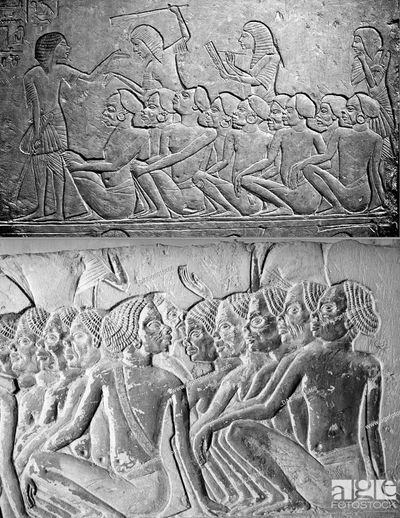
The particular depictions of ancient Nubians are among the most powerful and pervasive images used in Egyptology today, often favored by many Eurocentric-minded individuals. These representations suggest that the southern dark-skinned ancient Nubians were perpetually subject to the more advanced northern lighter-skinned ancient Egyptians, implying they were slaves.
The truth is that these individuals were not slaves, but rather Nubian captives or prisoners!
If the ancient Nubians were indeed backward and barbaric, as many people often suggest, how were they able to consistently challenge ancient Egypt for supremacy in the region, let alone supply their northern neighbors with skillfully crafted items like chairs, bedding, pottery, jewelry, luxurious goods, precious metals, and raw materials from the southern part of the African continent? Throughout these blog posts, it will become abundantly clear that modern Egyptology has severely limited and downplayed the important role of the Nubians in ancient Egyptian history.
Nonetheless, these excellently executed relief scenes show Nubian captives or prisoners from the Memphite tomb of General (later Pharaoh) Horemheb being kept under the close watch of stick-wielding Egyptian guards, while a scribe records them during the reign of Tutankhamen. The photos are courtesy of Bologna, Museo Civico, and DeAgostini/Getty Images.